Tuesday, August 21, 2012

Creation Corner w/ Lowell Washburn

Dove migration -- Cold Snap Brings New Arrivals‏


Last week's sudden "cold snap" must have really gotten the attention of doves living to the north of Iowa.  By Thursday afternoon [Aug 16] dove numbers appeared to be showing a noticeable increase across North Central Iowa.

By Saturday morning [Aug 18] there could be little question that the 2012 dove migration was on.  At weedy gathering points, dove hunting enthusiasts reported flushing a dozen or more doves at a time.  Birds were everywhere --- on the ground, in the air, roosted in nearby tree lines.

A friend of mine visited a willow batt he plans to hunt Opening Day.  Although only a dozen to 20 doves normally exit the willow patch at daylight, there are usually doves flying back and forth around the area most of the morning.  But what my friend saw this weekend was incredible.  As daylight arrived, he witnessed what he estimated to be at least 250 doves exit the willows with a roar of wings.  Doves were soon flying everywhere and he said that it was the most [doves] he'd seen anywhere --- ever.
Final Thought:  The doves are here.  Local hunters are poised and chomping at the bit.  The big question will be if we can keep the new arrivals here until the September 1st Dove Opener finally arrives.  I remember hunting a Sept. 1st Dove Opener near Princeton, Missouri two days after a sharp cold front had rolled across the area.  Although the area had been crawling with birds, more than half [most?] had departed just before the opener.  Needless to say, our weekend success was a huge let down!   

Friday, August 17, 2012

Bits & Balderdash

Just wanted to check in and give an update on stuff. This has bee a whirlwind couple of weeks for the Cox's!

Senior High Camp: I was privileged to serve as a counselor at the Iowa Regular Baptist Camp for the week of senior high camp. What a blast! Somewhere around 450-500 campers, counselors and staff; great weather and incredible activities not to mention the chapel services.

A couple of highlights from Sr. High Camp: 1.) The FBBC Contenders skits were off the hook! These guys & gals did a great job in communicating biblical truth in a serious and sometimes hilarious way! My favorites were "Baggage"; "Grace"; "Adam & Eve" & "Superhero Superstore". Good stuff! 2.) The music for the evening services was again this year fantastic! Tim Jones did an incredible job of once again using a mix of hymns and praise and worship music to set the stage for God to work. I'm so thankful for Tim's ministry!

Vacation Bible School: the week following Sr. High Camp our church hosted a VBS. our theme was Ancient Babylon looking at the lessons to be learned from Daniel. Our VBS is headed up by Doreen Nichols and she always dose an incredible job. Again this year, she transformed our fellowship hall into a Babylonian marketplace complete with shops and a bakery!

We had our highest attendance on Wednesday evening with 33 and for our church that is a great number of children! Our offer project this year was for the Shepherds ministry "Christmas in July".

Family Camp #5: Following a week of VBS, Lynn and I transitioned out to Family Camp at the Iowa Regular Baptist Camp; not for a week of vacation but I had been asked to be the evening speaker for the week. This was a huge honor and I chose to preach the series on the Book of Ruth which I had just preached in our church. These messages were very well received and judging from the feed back I've gotten, well used of God in the lives of the family campers.

Others speakers for the week were Missionary Gerald Hawk and Pastor Scott Onofrio. The program chairman for the week was Pastor Doug Farrell. The theme for the summer at camp was "Superhero Training Camp". It was a tremendous pleasure to serve with these men!

The Hawk Family
The Onofrio Family
The Farrell Family
Wow! A very busy three weeks of ministry, but we would want it no other way! What is next on the agenda....

I Remain,
Pastor Steve  

Tuesday, August 14, 2012

Creation Corner with Lowell Washburn

It may be later than you think...

This morning I picked my first batch of fall mushrooms -- found three patches of Chicken of the Woods.  The mushrooms were so fresh that you could literally squeeze water out of them.  Last year I didn't find any until mid-September, and was still eating them during the early duck season [attached teal photo].
Immediately after cooking my first skillet full, I stopped by Doug Duesenberg's Downtown 66 [a.k.a. Doug's Thrift Shop] to let him know that the hatch was on.  Doug loves Chicken Of The Woods, but noted that while delicious, the fungus is also extremely rich.  Steve Schutte was also on hand at the Thrift Shop -- dispensing his usual free advise from atop the cracker [or in this case oil] barrel -- and gave Doug, along with the rest of us, a free cooking tip.
"If you dramatically increase the amount of butter you're using to fry the mushrooms, it will automatically reduce the richness," said Schutte.  WOW -- None of us had ever thought of that one.  The suggestion certainly made sense.  Guess that's why Steve is considered a culinary genius.


Wednesday, August 01, 2012

Lessons from Colorado


There is, has been and will continue be a plethora of words written about the shooting in Aurora, Colorado. However, to this point I have read nothing better than the essay written by Dr. Bauder. I'm posting it here for your convenience.


I find it very thought provoking...


I Remain, 

Pastor Steve


Lessons from Colorado
Kevin T. Bauder


For the third time the state of Colorado has witnessed a murderer run amok. The first occasion took place in 1999 at Columbine High School. The second occurred in 2007 at the offices of Youth With A Mission in Arvada and in the New Life Church in Colorado Springs. The most recent, and the bloodiest, has just taken place in the Century 16 Theater in Aurora. Given these episodes and others like them, certain lessons are worth pointing out.

The first is that human suffering is real. The mayhem within the theater was only the beginning of the anguish that will result from one individual’s sinful choices. The pain of this event will scar many people for many years. Individuals who were not touched by the bullets were nevertheless touched by the trauma. The victims include loved ones who were not even in the theater but whose lives will never be the same because of the terror that was let loose. In the face of such suffering, no feeling person can remain unmoved. Our hearts go out to those whose lives have been ended or forever altered by this crime. Our souls yearn for the appearance of the One who will bring true and lasting peace and righteousness to the earth.

The second lesson is that evil is real. The murderer has already been characterized by many as a psychopath, but even psychosis does not have to result in this kind of slaughter. An individual made a choice to unleash horror. He did not accomplish this deed in a moment. He had a bright mind, he planned carefully, and he acted in ways that were calculated to bring maximum hurt to people who had never harmed him. Whether or not some pathology was involved, this act was vicious and malevolent. The right word for this man and his deed is evil. In a fallen world, the existence of evil must be taken into account. Christians should allow no naïve utopianism to stand unchallenged. Evil is alive and well on planet earth.

Third, governments cannot stop the sort of evil that occurred at Century 16. They have only a limited ability to defend their citizens from this kind of violence. Officers of the law despair of being able to stop such crimes. Commenting on this kind of event—random shootings perpetrated by lone gunmen—former FBI agent Peter Ahern said, “There’s no way you can prevent it. There’s absolutely no way.”

In a sense, Ahern is too pessimistic. There are ways to strongly tilt the odds against another mass shooting. For example, the government could outlaw public gatherings of more than three people. Or it could release squads of police officers to conduct random searches in homes and on the streets, arresting anyone whom they suspect might commit a crime. Such measures, however, are so draconian that they would actually produce greater harm than good. The liberties that citizens would surrender are far more important than the risk of being caught in a random shooting.

Fourth, when governments cannot protect their citizens, it becomes prudent and even necessary for citizens to attend to their own protection. People have no obligation to permit themselves to be struck down by predators and evil men. On the contrary, they have a right to defend their lives, limbs, and property. They also have a duty (when it is within their power) to defend the innocent.

Fifth, sometimes the restraint of violence calls for violence. The cliché that violence always begets violence is an affectation of navel-gazing mystics and the Woodstock generation. Sometimes violence, when it is rightly administered, brings an end to violence. Sometimes the just exercise of violence is the only way to end unjust violence. Sometimes peace is achieved through strength. No qualitative difference exists between calling on someone else (such as the police) to exert force in one’s behalf and exerting force for one’s self. If they were consistent, people who object to using violence against violence would never call for the police when they were being assaulted.

Incidentally, the allowance of violence in the exercise of justice is one of the principal differences between Baptists and Anabaptists. This is not the time to revisit the arguments (though they should be reviewed, perhaps in a future essay), but Baptists have believed that Scripture supports the right of just authorities to wage war and to execute certain criminals. Together with other Christians they have also believed that, under most circumstances, Scripture allows for the use of deadly force in the defense of one’s self and the lives of others. Baptists have been willing to serve as magistrates, to fight in just wars, and to take (predatory) life in the defense of (innocent) life.

Sixth, if the defense of life is ever a right—let alone a duty—then any law that deprives people of the necessary means of defense is an unjust law. It is a law that moral people may disregard. When a government forbids the means of self-defense (as distinct from state defense, which requires weapons of war), then it is overstepping its licit authority. From a biblical point of view, it may and often should be safely disobeyed.

Seventh, one of the worst ways of exposing people to violence is to herd them into zones in which they are publicly labeled as defenseless victims. This is precisely what happened at the Century 16 Theater. The state of Colorado allows its citizens to carry the means of defense, but both Century 16 and its parent company, Cinemark Century Theaters, disallow it. The predator (a bright guy from all accounts) did not plan to shoot up a police station. He planned his assault for a location filled with disarmed, defenseless victims. If the Century 16 Theater had permitted the necessary means of defense, the result would have been much the same as if the shooting had occurred in a police station. The death toll could have remained as low as two: the first victim and the perpetrator. Century 16 and Cinemark bear part of the responsibility for this catastrophe.

To understand this point, one need only consider the disparity between Colorado’s three recent shooting sprees. The Columbine shooting and the Cinemark shooting both occurred in disarmed-victim zones, and in each episode the death toll was staggering. The other shooting spree (the one that began at YWAM and ended at New Life Church), however, was cut short when a church lady, Jean Assam, applied the necessary means of defense to the shooter. This is the spree that fewer people remember, probably because it hardly began before it ended.

Some have suggested that a believer should willingly exchange his life for the life of an assailant. They reason that the believer, if killed, goes straight to heaven, but if the assailant is killed he loses every opportunity for salvation. This theory may work when the believer is entering an assailant’s territory and no other good is being risked (e.g., Jim Eliot and Nate Saint refusing to fire upon the Aucas).

Imagine the chaos that would result if every Christian police officer tried to live (which is to say, die) by this theory. No, the theory is terribly myopic, in part because it takes no account of further harm that the assailant will do, both to believers and unbelievers. Granted, application of the means of self defense within the Century 16 Theater may have ended the assailant’s opportunity for salvation. Not being able to apply that means, however, ended the opportunities of many more people. Given a choice, it would be better to see the perpetrator being carried out and a dozen others granted the chance to repent.

(This essay is by Kevin T. Bauder, Research Professor of Historical and Systematic Theology at Central Baptist Theological Seminary. Not every one of the professors, students, or alumni of Central Seminary necessarily agrees with every opinion that it expresses.)


Monday, July 30, 2012

Creation Corner with Lowell Washburn


             Summer Dog Days Provide Sultry Backdrop for Predator & Prey
                              By Lowell Washburn

The Dog Days of summer are upon us.  August is just around the corner and, right on schedule, this year’s crop of annual cicadas are making their above ground debut.  Within hours of their appearance, the distinctive chorus of hopeful males began to fill the humid afternoon air.  The “scissor grinder’s” trilling is impossible to miss.  Surpassing 100 decibels; the sound is the insect equivalent of a power saw and can easily be heard above your neighbor’s roaring lawn mower.

For many folks, the cicada’s song provides an audible reminder that summer heat is on borrowed time.  For others, the harsh buzzing is regarded as just one more item on the growing list of hot weather annoyances.  But for the giant cicada killer wasp, the outlook is much different.  As far as this formidable amber-winged predator is concerned, the cicada’s noisy rattling is simply the sweetest music ever heard.  For currently emerging cicadas, the huge wasps represent the very worst nightmare the world has to offer.

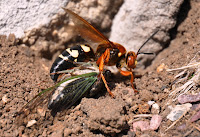
For anyone who has had an opportunity to admire a specimen at close range, it will come as no surprise that the giant cicada killer is Iowa’s largest species of wasp.  For weeks now, these solitary hunters have been busily preparing for the annual emergence of adult cicadas.  After selecting a well drained, usually sandy location, female wasps begin digging elaborate tunnels containing several side chambers --- kind of like the hallway of a subterranean hotel.  Although cicada killer wasps are solitary [meaning they don’t live in large, highly organized colonies] multiple females may share a single tunnel.  Although most excavations are smaller, tunnels can go as deep as two feet and extend for five or six feet.  

Once a side chamber is completed, the female who dug it immediately goes on the hunt for cicadas.  Searching the upper canopy of deciduous forests and urban shade trees, the predacious wasps appear to relentlessly scour each and every leaf in search of game.  I’ve read that cicada killers readily home in on the sound of singing [male] cicadas.  Sounds reasonable, except that the wasps I’ve spent time observing bring in at least as many female cicadas as they do males.  Even if cicada killers do use sound to locate prey, it seems to me that visual cues must be equally important.  Here in north central Iowa, the past week was easily the best for wasp watching so far this summer, with individual hunt times running as low as 12 to 15 minutes.  Cicadas being brought to the lek I have been observing ran about 2 females for each male, with peak hunting activity occurring at a time when the buzz of male cicadas provided a constant audio backdrop.   

Regardless of what hunt strategy is actually employed, there are some constants.  As soon as an adult cicada is located, the wasp delivers a powerful sting; injecting a potent shot of venom that immediately overpowers and totally immobilizes its victim.  The powerful wasp then airlifts its heavy cargo back to the tunnel.  The higher the cicada is located in a tree, the easier the flight back home.  In spite of the cicada’s weight and bulk, the incoming wasp usually dead centers the tunnel’s entrance so precisely that you barely have time to catch even a fleeting glimpse before the cicada and its captor disappear into the hole.  On windy or extremely humid days, incoming wasps seem more likely to miss the mark and may end up having to drag their cargo the last few inches to the tunnel.

Once an immobilized cicada is spirited below ground, the scenario’s creep factor escalates dramatically.  What began for the cicada as a sunny afternoon of singing in the treetops has suddenly become a living nightmare of Stephen King proportions.  But the worst is yet to come, and what lies ahead for the comatose insect isn’t likely to make the Mother Goose list of suggested bedtime readings for toddlers any time soon.  In the true life world of the outdoors, Walt Disney story lines are few and far between; and fact is often scarier than science fiction.  Let’s continue.

Upon finally reaching the inky blackness of its preprepared underground chamber, the female cicada killer drops her prey onto the floor the cramped room.  She then lays a single egg on her victim.  Mission accomplished, the wasp seals the chamber’s entrance with a sodden door and leaves.  Like a fresh side of beef hanging in the local locker, the cicada lies on its back and waits.  In two or three days the attached egg hatches, and the wasp larvae immediately begins to devour its helpless, protein packed host.  Meanwhile, the female is busy constructing new ‘guest chambers’ and continues filling the nursery -- one stunned cicada at a time.  Although their time is short -- all adult wasps will die before winter -- the predators make the most of what days they have.  During the four weeks or so that it will spend on the hunt, a female may capture 100 or more cicadas.

With its amped up demeanor, pulsing abdomen, bright colors, loud wings and huge size; Iowa’s giant cicada killer wasp projects an ominous air.  But in reality, humans have little to fear.  For the most part, cicada killers are all about the hunt.  Unlike colony nesting wasps and hornets whose lives are directed toward protecting a communal hive, cicada killers are extremely tolerant of human intrusion --- at least under most circumstances.  Even though I’ve given tunnel digging and cicada toting females plenty of just provocation to sting, the harshest rebuke I’ve received so far was a stern warning rattle of the wings -- at which point I immediately backed off and let the creatures go.  I think the females are simply conserving their venom for future cicadas, or maybe they just think I’m too big to drag down the tunnel.
 
Final Thought:  The wonders and complexities of creation are never fully explored, nor are they ever completely understood.  Things that appear simple at a glance, rarely are.  The inseparably intertwined lives of the annual cicada and the cicada killer wasp present a portrait of two seemingly disconnected and unrelated species each living out the adolescent stages of their lives in complete ignorance of the other, yet both headed on a direct and completely predictable collision course to an unavoidable convergence that will occur, right on schedule, late each summer.

Cicadas that survive predators will deposit their eggs in slits they slice into the bark of tender tree branches.  Cicada eggs hatch, nymphs drop and borough into the ground where they will spend the next three to five years using spear-like siphons to tap tree roots for sap.  When the timing is perfect, maturing nymphs suddenly tunnel to the surface.  Climbing a nearby tree trunk, the nymph splits its plastic-like skin down the back and the anvil headed, clear winged adult we all recognize emerges.  Within hours, the sound of singing cicadas fills the sultry summer air.  Although the adults are actually at least three or more years old, they are called annual cicadas because “a hatch” emerges above ground each summer.

Right now, the first cicada killer eggs have already hatched and larvae are voraciously consuming their paralyzed hosts -- one stunned cicada for baby males, but two or three for growing females [The mother knows in advance which gender an egg will become].  Once the meal is complete, larvae will spin a cocoon of sorts and then go dormant for the remainder of the summer, fall, and winter in the underground room its now deceased mother constructed.  The wasp larvae will pupate late next spring, and the annual crop of giant cicada killers will appear, right on schedule, in late July of 2013 --- just in time to make hurried preparations for the impending emergence of the annual cicada when, with all the precision of a finely crafted Swiss watch, the lives of two seemingly unrelated species will converge in perfect synchrony.      
 
To every thing there is a season, and a time to every purpose under heaven.
                                                      Ecclesiastes 3:1                                                                                               

__________________________________________________
PHOTOS:
 1 -- A female cicada begins digging its tunnel
 2 -- With side chamber completed, the wasp begins the hunt
 3 -- A newly emerged annual cicada
 4 -- Incoming - An adult female brings home the bacon
 5 -- A female cicada killer [Tunnel #9] and its prey
 6 -- A female cicada killer [Tunnel #6] and its prey
 7 -- A female cicada killer drags its heavy cargo into Tunnel 6
 8 -- Another female leaves the lek to search for cicadas
 9 – Adult female

#1
#2


#3
#4
#5a


#5b

#6

#7

#8

#9